Showing posts with label blogging. Show all posts

Tuesday, January 19, 2016

Genealogy offline: A question of access, investment, and wayfinding

It comes to me very often that the problem of genealogy is that the instructions are all together too prescriptive. If this, do this. If that, do that. 

One of the most common tropes that I see in blogs is that "it's not all online", and then proceeds to talk about records that exist as if they are the same for everyone in every state and every country.

I think the biggest thing I learned in 2015 is that there really aren't standard records available everywhere for everyone from every time period. Sounds easy, right? I mean, NY is not the same as IL or MI. But I think genealogy can fool you into thinking this is the case, because so much of our training is about making lists. 

For example:
-Found an ancestor who lived 1800-1890.
1.got the US censuses for 1850, 1860, 1870, 1880.
2. then research helpers suggest finding state censuses for the 5 year marks in between (1855, 1865, etc.). 
3. then they suggest looking for newspaper articles to fill in
4. then they suggest looking for vital records to fill in
5. then they suggest looking for land records to fill in
6. then they suggest looking for military records to fill in.
7. then you get into the land of offline records: schools, letters, books, etc. 

The problem with this prescriptive approach is that with the online records available, people are facing an onslaught of information all at once, and get paralyzed at a certain level. Many people stop somewhere in between steps 1-4 and never hit steps 5-7. If they do hit steps 5-7, they get flustered when they can't find what the list says they should be able to find.

The problem with offline records (and even blended offline/online where the database index is online and you have to order for offline delivery) is three parts:
1. Access - generally you have to have access to a physical address to get access to a particular record, or to search when the particular search you started with doesn't work for one reason or another (spelling-ARGH!).
2. Investment - you're going to spend more per record search, consultant hire,or copy fees in terms of dollars. In terms of time, its going to take a lot longer to search offline that it is with a fully indexed record on FamilySearch or Ancestry.
3. Wayfinding - you have to be able to find your way to the proper archive. Sometimes this is easy, if they have a website with clearly listed records that you can plan to find. Other times it takes a series of phone calls, emails, and visits to come to find out if your record is actually at that location OR has been taken elsewhere OR destroyed OR you're in completely the wrong spot entirely. 

Wayfinding is often the hardest part of the problem, because sometimes even the archivists don't know about record availability for a certain time period. I was recently at the NY State Archive, and came back home and found out that what they had told me was false information. Or when I was in Watertown, NY, the local librarian/genealogist/history buff told me information didn't exist any more - which was only partially true, part had been filmed eons ago by the LDS-FamilySearch folks. It wasn't because they didn't like me or didn't want to help me, it was just that they were specialists in their particular part of the archive and not other parts or other archives.

Generally speaking though, you have to know where to go, what you can spend, and how you can get to offline records, and then expect that there is massive variation in what is available. One county might have every state census back to the first immigrants. The one next door might only have a few decades worth. Having the flexibility in-brain to say that this variation is okay and being able to move onto the next part of the search (or hopping off the search path entirely) is a valuable skill that is only honed through practiced off-line research, so its no wonder that people are scared and wondering why they can't find something that they saw online for somewhere else. 

We have to stop prescribing to every genealogy problem a list of steps. We need to encourage people to cast a net, catch all the fish, sort the little fish from the big fish, sort the types of fish, and then figure out which ones to bring home for dinner, and then figure out where to cast the net again, to borrow a metaphor. The net can go many places - offline, online, to a consultant, to a volunteer - but it doesn't need to go in a certain order or the same places every time in order to catch some fish for dinner. 

Friday, April 16, 2010

Knitting, Blogging, Swap Sending!


To start, I'm extremely happy that my latest project is blocking and drying right now. I'm hoping to take it to the knitting group tonight and show it off before I have to mail it as the swap package. Sorry for the lack of pictures of it but I do want her to have some surprise!

I've been catching up on emails. Its hard to believe in 3 years I'd accumulate 6000 emails, even if they are all neatly labeled and sorted.

Amber Naslund is a great writer. Rarely do I find blogs that make me think as much as hers. Her insight is valuable to me and yet I am certainly not a "social media expert" of any kind. LOL - I have a micro-business but that's as close as it gets.

Crafting in Yoohooville is a great micro-company for me. I build it when I can, and it rewards me by keeping my brain active. It also feeds my need for control of at least a small part of my own destiny. What does the company do? Well, not much yet, but its slowly but surely building. I'd rather not release a product until I know its of a quality that I value, and I know my work isn't there yet. I've given myself a deadline to get this product out into the marketplace, and so far, my development schedule is being met.

Anyway, check out the post that I linked to of Amber's. Its awesome. I cracked up when I read #5, because so many of the knitting and designer blogs I see have that exact problem - if you read the same thing 6 times, and that pattern is repeated over and over, you're certainly not going to want to come back for more. My blog's not a moneymaker, it doesn't do much, but I'd like to think that I'm pointing out something different than the pack each time I write something.

So here's what I have.

#1 - if you want to write your own knitting or design blog, keep the ideas in your designer notebook. Start posting your mood boards. Start posting your inspirational photos. Do whatever it takes, but make it yours. Don't make your blog the same as the Yarn Harlot. I really don't think anyone cares about any interpretation of what she writes outside her blog. I'm sure I'll get some hate mail for that, but its what I think.

#2 - I would love it if I saw more sketches in a blog. Come on, if we're knitting and crochet designers (even amateurs), we should be able to show off some sort of design skill to the public. How many sketches do people have that will never see the light of day because the idea just won't work in real life? I know I have notebooks full.

#3 - Just because I said it, doesn't mean you have to do it. ::grins:: I know that sounds contradictory, but its true. Follow your own ideas for your blog and don't worry about whether its perfect, boring, or nonsensical to anyone but yourself. As long as you write with feeling and knowledge, people *will* keep coming back for more.

Wednesday, January 20, 2010

Snakes, Tacos, and Crafting

I haven't posted here for about a month, so I wanted to assure everyone that I am

a)still alive
b)still crafting
c)still interested in blogging.

:-D

However, my time isn't always as well planned as it should be and I forget to make the posts that I had wanted to make. However, I am hoping that will change with the advent of planned blogging.

Its a concept I read on another person's blog (yes, I do read many blogs, usually via email since I can always download my email and read it offline). Instead of blogging "when you think about it", you set up a series of blogs in one day, and delay their posting until they meet set intervals. Interesting concept...

Then when you want to blog, you can also post "whenever", but once a month you plan the programming for the next month. That's where the word "genius" comes to mind!

So I'll try that in February. We'll see how it goes :-)

But back to the topic at hand....

The Sea Snake

Doesn't that look like what a glamorous Sea Snake should look like? Its a wonderful pattern by Nancy Nagle of Nangelli.com called "Delicious Diamond".

If you're interested, its a free Ravelry download, too. I found it to be quite fun to work and really worked to the advantage of the short fur style yarn.

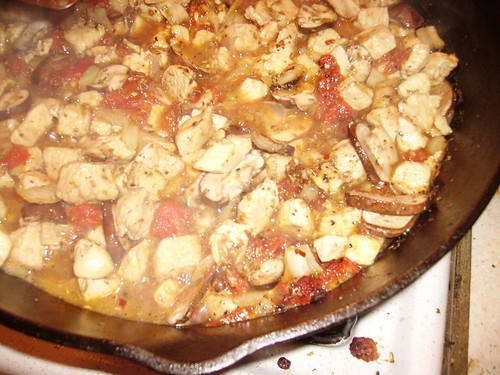
Chicken Tacos

Doesn't that look good? Sarahpark on Ravelry wrote up this nifty recipe which included those AND a pattern for a cast iron skillet pot handle.

new double layer pot handle cover happy :-)

Isn't that cute? It kind of reminds me of a fish, but it also makes Shawn happy and keeps his hand cool while cooking. A very fun test crochet project - I highly encourage you to to try it when she releases the pattern!

I've been working on some other things, but I'll save some stuff for this weekend to post.

Wednesday, March 4, 2009

Social Media - how much time does it take? (or the #1 question I get asked)

This is probably the top question I get asked, so I thought I'd list my time out here:

-Twitter: I check in a couple times a day, and scroll maybe the first page of tweets in my newsfeed. I post tweets more frequently, but those take maybe two minutes to write. - Total: app. one hour per day

-Facebook: Err...I spend a lot of time on here On days when I have to help the Jaycee groups I spend an extra hour - probably two hours a night and an hour spread across the day.

-Blogging/Reading Blogs: I don't blog as often as I should (guilty!), but I do spend a lot of time reading my favorite blogs (Frugal Dad, Retire at 40, Sustainablog, Construction Marketing Ideas, Seth Godin's Blog, Blog Maverick/Mark Cuban) - probably an hour a day total. If I write something for my blog make that an hour and a half.

-Ravelry/Craftster: I peruse at my leisure. I will go weeks without going on at all, and then stay on for hours a day. It all depends on that weeks content or if I'm looking for something. - probably fifteen minutes a day

-Email: I still spend a LOT of time on email - I run the mailing lists for my USGenWeb sites, interact with people on the Canadian ones and am an the National Advisory Board for USGenWeb - which translates into a ton of email. I also get a lot of newsletters sent to me because I'm terrible about checking websites. - Total spent across the day, 3 hours across 3 email accounts.

-Google: I've set up alerts for my name and my maiden name to see what comes up. Sometimes I have to play defense, but most of the time its a pleasant surprise to see my name in the news (even if its not me). - total spent: 10 minutes a day

-Flickr: I still post pics when I have time, but rarely do I do it when its not associated with Ravelry somehow. - maybe ten minutes or less each week

That being said, its not the majority of my day spent on the SM circuit. I still make plenty of time for working, knitting, eating and working out.

Anyway, what reminded me of this was the latest batch of emails I had received expressing wonder about how much time it took to do this and then there was a beautifully written piece at Museum 2.0 about the topic of how much time they spend doing things and what they recommend for time crunched museum peeps.

Wednesday, August 29, 2007

e.g, i.e., who knows?

Apparently, these people do:

Daily Writing Tips

A great brief explanation of why you should use one or the other! You should listen!