Monday, November 4, 2013

Cooperation

These days we so often hear about things that drive us apart. Politics. Religion. War. Intelligence. Marital status. Kids. And even when we hear about someone working together, we think of the most unpositive of motives. Profit. Greed. Price-fixing. Destruction. Hate. Envy. We seem to have lost, as a nation, the ability to hear people out for what they are doing - helping one another because they are human beings. So often I see people who feel they are always in competition with one another, not willing to give up an ounce of their time for others. There's a certain limit, of course, because we all have to guard our time with care to spend it on the things that we value. But I think everyone in the world knows someone who never gives time to anything and spends their time on what we would typically call selfish pursuits - drinking, gambling, whoring, mooching, drugging, clubbing, etc. And you just want to shake them and say "Don't you see what a negative influence you are on the world around you? Can't you see that the world exists beyond you?". Even when folks aren't driven by these activities, they are often so profit-minded that they spend all their time counting money rather than noticing the world around them.

That's why I love entrepreneurs like Richard Branson, Mark Cuban, Tony Hawk, and others, that give back so much to the business community. Yes, they are out to make money. And yes, they have their businesses. But they also know that by sharing their value, knowledge, and skill with other entrepreneurs and non-profits, that they can make this world a better place. They give transparent feedback without ulterior motive or suspicion, because that's who they are. They recognize talent. They share their knowledge and knowledge of opportunities because they know the world builds more from addition than subtraction.

I am so pleased that the knitting and crocheting community has come together to offer the Indie Gift a Long on Ravelry. Yes, you can absolutely compete to your heart's content if you want to. But if you don't, you can still take part in what amounts to the biggest discount campaign on independent patterns I've ever seen, and support people who have a small business, making their living doing what they love AND supporting their fellow designers.

So that's what I'm thankful for today - that people still come together to do things that are amazing, great and small.

[Side note: I wrote this on Sunday, but I set it to auto publish at noon on Monday, just in case my employer is wondering. And I thoroughly apologize if I offend anyone with the language in this blog entry.]

Sunday, November 3, 2013

Control and Surprise

I've been doing a lot of reading lately and watching a lot of new tv shows and of note, a lot of stories in which classic tales are turned in some way to make them fit the modern era and surprise us while still using characters that we know and love.

Cameron Jace, I feel, is one of the best at this. Classic fairy tales are cleared from the dust, brought back to their original liveliness, and moved into a story that surprises, delights, frustrates, and confounds. Sleepy Hollow, on Fox, was another great example, in which the classic events of British history are retold through the connection of the supernatural. My favorite tv show, Supernatural, even did a story where Dorothy Baum, grows up into a supernatural hunter and freedom fights for Oz. Dracula, the latest show that I've been watching, turns the staid story of Dracula and the Harkers into something new and magical (it helps to have Jonathan Rhys Meyers, of course).

What does this have to do with anything? So much in our lives tries to control, to stay the same, to preserve the same patterns that we live, over and over, to a point that even if we recognize them happening, we fall hopelessly into the same way of living and feel powerless to stop them from happening. Sometimes it feels like we grind the same stone, over and over, finding the same, painful ground, down condition.

I am grateful today that there are still delights in this world and surprises to be found. Even our classic stories have life left in them, to spawn new creativity and give us new tales of fun, mystery, love, and life. No matter what, life can still throw you something new that makes your world shiny, new, and exciting, even in the most mundane situation. 

Saturday, November 2, 2013

Being Grateful

Yesterday was the start of 30 days of being grateful. Rather than write some BS post about being grateful that I didn't feel yet, I started by framing my senses on gratefulness. Its often said that Buddha said something along the lines of "you will attract what you expect" or are, and that the Buddha teaches people to be more grateful.

In all honesty, it was tough to even think about it in a gray, rainy day where everyone was hung over on candy and partying from the holiday. Then I saw this video:


Look at the tenacity that little mouse displayed. He tries and tries, and eventually, he gets his cookie. It made me smile, and it changed my whole point of reference for the day. If someone as small as a mouse can get what he expected by sheer force of will, perhaps I could get there too.

Today I am grateful for the smallest thing - Amazon delivered to my apartment facial tissue, bathroom supplies, and other things that are no fun to shop for. This small comfort (at a good price) made my Saturday a good one. 

Wednesday, September 11, 2013

MUST SAVE ALL THE THINGS....Thoughts on managing information & stuff


I have been in a destash mode lately. I've been realizing that part of my issue with life right now is I am too beholden to too many things, activities, emails, etc. So I've been thinking carefully about responsibility, and whether it needs to be my responsibility OR if it could be someone else's. My boss is wonderful about reminding me what is my responsibility at work and when its best to let go of the other stuff. Too bad I don't have someone in life like that LOL.

As a part of this, I've been studying different tools to manage the information that I have and find better ways of doing things. I am currently listening to a Legacy Family Tree Webinar (seriously, if you haven't found these and you're into genealogy or family history, run, don't walk to this link. Each month, one is free to view or you can watch hundreds for a small fee per month) and one of the tools that Thomas MacEntee is presenting is Evernote.

I've had Evernote on my computer/phone for awhile but haven't used it, because most people present it as a way to categorize and save everything that you find. At this point, I don't want to hoarde any more information unless its directly of value to my family tree or for something that I am planning to use in knitting or crocheting. Every time I see someone present about Evernote, its about hoarding more information. And yet - Thomas presented something different, a way to organize your thoughts, your photos, and your documents associated with your tree. Mind semi-blown - a better way to use Evernote that I hadn't thought of, and that might prove more useful.

As he presented on, it made my ponder the nature of the hobby - we are researchers, detectives, and path blazers, solving logic problems and finding new ways to figure out how to find and remember people who may have died 300+ years ago. When I thought about it, it is not all that different from the way people knit, crochet, and spin now - we research (via pattern), we act as detectives (finding the right yarn, needles, hooks, accessories), and path blazers (tweaking or fixing patterns as needed), solving logic problems (gosh dang stitch count errors, typos, etc.), and find new ways to do heels and fingers and things that our ancestors hadn't thought of (can you imagine a sock that had to be sewn together because it was knit flat?).

When it comes down to it, genealogists and family historians save tools, software, information, documents, photos, and mementos. Knitters and crocheters save tools, software, information, documents, photos, yarn, and mementos/finished objects. We're not that different really - its no wonder why there are so many folks who do both.

The problem with the saving of all these things is that especially in today's day and age, information, software, documents, and photos, change super rapidly. It quickly becomes a problem that we need to convert over to the next generation of tools and software to keep that information alive. And sometimes its kept on the Internet, and sometimes it doesn't (and sometimes I wish it went away!). So we end up with a scattershot approach, because we don't want to use yet another tool to manage what's become quickly a monster - Evernote for genealogy, Ravelry for stash/queue/pattern library.

What I've come to realize as a part of listening to this is, it's okay to not have everything. It's okay to let that stash go, to not save every piece of genealogy data because it might be important, because I've realized that in my lifetime, the amount of information, stash, and knitting/crocheting I will be able to do is far exceeded by how much I have. What I can do is focus. Hone in on what I enjoy and whom I want to work on at any given time. Remove the extras so that focus can come naturally. I want to be the expert on certain people, and certain topics, and the only way I can do that to focus.  Yes, I hacked limbs off the family tree - but that's because quite frankly, other trees had them well covered and I don't need to intertwine my branches with theirs. Other folks have very skinny limbs with little trees in the forest, so I've kept them along. It's the same with my knitting/crocheting - I've pruned my queue and have been trying to slow down on starting new projects without finishing others, stopping my pattern testing, etc. so that I can finish my own designs, finish projects, and use my yarn. But it takes SO much discipline! Sometimes I fail, and I have to pick myself up and start again. It's okay!

The process I went through is hardly unique, and they are not alone in coming to this same realization. We're all struggling with this same issue of saving overload no matter what the area, and we ought to work together more often in order to help each other figure this out.

Wednesday, August 21, 2013

Microblogging the Chicago E-Learning and Technology Showcase

I had a great time yesterday learning about e-learning and m-learning at the Chicago E-Learning and Technology Showcase. It was fascinating being around people who work in the same field.

I again rekindled my love affair of using Twitter practically, usefully, and interactively by live tweeting my sessions. All the tweets from the conference can be found below.

I found it very interesting that at an e-learning and tech showcase that:
1. All the sessions were live, classroom style rather than interactive, showcasing the tools we use to deliver content. There was one hands on lab,  but that was it!
2. There was barely anyone tweeting, which, for a tech event, seems very unusual. When I went to the national ASTD conference, for example, there were streams and streams of tweets in order to catch all of the content that was going on at any given time.
3. There were SO many paper handouts! And they ran out of them! Which is just silly. We're at a conference about digital learning - all the presentations should have been made available for all participants at the conference on the portal immediately, facilitating different kinds of interaction with the content.

Twitter can be so useful to use for real things other than the usual "What I ate for breakfast" tweets. I don't use my Twitter that way - sometimes all that goes to it is my horoscope because I don't feel that I need to bother people with things that are useless information. When I have something to say, I say it, and I love to interact with people about it. Its less about Twitter as the reporting place and more about the interaction Twitter facilitates for me. I was talking to some people at the conference yesterday and mentioned that live tweeting, in particular, is a way to force myself to pay attention and engage with the content in a different way, even if I want to scream about the poor presentation style or lack of adult learning principles being used or simply poor planning.

I'm really excited about the possibilities of mLearning in particular as I think its the direction that people are going to go. What worries me is the potential of downgrading our attention spans further. In the presentation I was in, it was mentioned that mLearning for phones should be no longer than 3 minutes, for tables 15 minutes, and for PCs no more than 45 minutes. That's totally accurate, in my opinion. People go crazy now over a 45 minute survey where in the past an hour or more of writing would not be unusual in a major survey. I can only imagine when education is broken into 3 minute chunks how people's attention spans are going to move shorter and shorter until the point that we can't even sit still for a 1 hour classroom experience. But at the same time, being able to reach someone at the exact time and situation in which they need their education brings to mind dazzling possibilities of effectiveness and efficiency in education that aren't currently possible with the 1 hour classroom block (of which 90% of learning will be lost within 90 days).

So all in all, a mix of experiences at this conference that were interesting and thought provoking on my way home last night. Would I go back next year? Possibly. I'm thinking we need to show off what we are doing for work here, because I think my coworkers are doing amazing things with limited resources in a blended model of live, live remote, eLearning, mLearning, and textual learning education. 

Tuesday, November 20, 2012

Charlie Brown, Blogging, and the video you need to watch *now*

I was reading around the Internet as I usually do, and found some inspiring posts. First off, if you are in need of something inspiring (or something to procrastinate with, I don't judge), you should watch Amber Naslund's presentation at TedX Peachtree.

I started writing this post because I read an entertaining column on Charlie Brown and its relevance to blog writing - I'm a Linus VanPelt, entertainingly. (Go over and read Carrie Keenan's column "Do You Blog Like Charlie Brown?" - go ahead, I'll wait)
"Linus VanPelt -  Linus is a very conscientious researcher but he lets his research take over and go off into tangents and analogies that don’t quite make sense."
I'm totally Linus - I do love to research and go off on tangents...oops, I'm getting off topic from what I started from! :-) 


This sort of collides with a discussion I was having this week with a friend. She was asking me why I don't blog every day without fail. I had to say that I think its more important to have a message, an important thought, that I've researched and thought about in the car, in the shower, and so much that I can't live without sharing. 
Amber, in particular, is a role model of mine, even before I knew about her experience with mental illness. Why? Her blog is exactly what I think a blog should be - thought provoking, not necessarily about the same thing, but loosely based around a theme, not posting every day but often enough that I remember to check my email for her entry. I get the feeling that her entries are incredibly personal, no matter what the conversation is like, and not that she's cranking them out all the time because she's required to. I used to subscribe to Seth Godin's blog before I realized that he cranks out posts and while I find the questions he proposes thought provoking (on occasion) there is no substance there. I can't say I remember a single entry of his, where I've already talked to multiple people about Amber's blog entry and video.
Every time I read an Amber Naslund post, I sit there and think about it. More than one have shaped and changed my own behavior, both online and offline. That's what a blog should do - rather than meeting some sort of arbitrary schedule that results in posts that are fluff, useless, and don't stick to your brain like a meat and potatoes meal sticks to your ribs. 
I honestly don't care that I get a lot of comments. I don't care that my long posts violate a lot of bloggers so-called rules. I don't care that some people may not give a hoot what I write about, or that they tell me I'm wrong (I'm always open to change, so I appreciate them telling me, but I will firmly make my own decision). I care that I talk to people in real life that tell me they helped save their genealogy society by trying something new, or that they tried their hand at loom knitting because I made it seem so easy that they could do it and could open their mind beyond knitting = 2 sticks, or that I brought up something in my blog that really reached them about the quality of another writer or a designer. Its those real life moments that make writing this blog so much fun, and that's something a lot of folks I see writing a blog don't say. I see and hear a lot of people who say their blog is their job, their drag, their requirement. For me, its a fun part to say something where I can actually spell it all out before people interrupt my thought pattern and my own brain starts racing a mile a minute with the response, or to process what they're saying. 
I often think about the idea of the intellectual salons of France of the 18th century, and in my fantasy of them, I can bring together my favorite bloggers such as Amber, Hannah from Bittersweet, Judy from The Legal Genealogist, Mardee from Mardeeknits, and Molly Erdman from Catalog Knitting. What would we talk about? No idea, but it would go off on some interesting winding path that wouldn't be possible elsewhere, like a good knit-crochet night with friends. 
Err...getting off on that tangent again. My point through this post is that I never would have guessed that Amber has lived with a mental illness as long as she has revealed in her video. From reading my own writing, I never would have guessed that about myself, either. Maybe that's why her work speaks to me so much - I get *it*. So I want to acquiesce to her request and say - add me too. I've had anxiety disorder for nearing 10 years, and I still have those moments where I have to hide in order to be able to breathe, but I can live and do everything I need to. This blog is one of my coping mechanisms - my thoughts onto paper slow down my brain enough to do what I need to do. My brother has ADD, and has had to also find coping mechanisms to make things work. Medications are only one piece of the puzzle - and I think that writing and meditative activities such as meditation, yoga, knitting, crocheting, etc. are another, and sharing with one another that we have these needs are incredibly important.

Kudos to Amber for having the courage to get up there and talk about it. I'm glad to be a part of her audience.

Monday, October 15, 2012

Théière au crochet (Crocheted Tiny Teapots)

I started doing translation of knitting and crocheting patterns awhile back when the Internet was more of a Wild West and resources like Babelfish and Google Translate weren't available. That way I could share fiber arts fever with the rest of the world, or at least to my non-English speaking neighbors.

Once in awhile, an opportunity develops to help out once again. Yes, you can translate patterns with Google Translate, but you end up with a text that sounds like its talking about swords, mesh, and air stitches. Its just not set up to do the specialized language of translating knitting and crocheting language. Tsitsa Tsitsa on Ravelry has a wonderful blog called Bulle de tut'Oz where she shares patterns with the French speaking world. Seriously, check out her adorable dog crown! A Ravelry user asked her permission to get one of her patterns translated, and so I am posting the translation here.

Never used a translation before? Here's what to do. Load up the original pattern in one window. Put that on the side of your monitor. You'll need it to see the copyrighted illustrations and photos from the original. On the other side of the window, keep this screen open. You'll then be able to follow both, side by side.

Please go see her adorable teapots when you get a chance. They are so tiny and lovely! I have intentions to get to them after my class is over - my mother would love a teapot chain decoration like them. If you like them and intend to do a project, go to her page on Ravelry and enter the project.

All terms are translated into American crochet terminology.

The Micro-Teapot by Tsitsa Tsitsa

Abbreviations:
sc = single crochet
sc2tog = single crochet two together (decrease)
sl st = slip stitch
ch = chain
sts = stitches


The body of the teapot (to start at the top of the pot)
Row 1: Chain 3 stitches and close round with 1 sl st.
Row 2: Ch 1, 6 sc, with 1 sl st.
Row 3: Ch 1, 2 sc in each sc from previous row, close with 1 sl st (= 12 sc).
Row 4: ch 1, * sc in 2 sc from previous row, 1 sc *, repeat from * to * until end of row and end with 1 sl st (= 18 sc).
Rows 5, 6, 7, 8 and 9: Ch 1, 18 sc, with 1 sl st.
Row 10: ch 1, * sc2tog, 1 sc *, repeat from * to end of row and end with 1 sl st (= 12 sc). Put the stuffing in.
Row 11: Ch 1, sc2tog until the end of the row and then close with 1 sl st (= 6 sc). Cut the thread and pull to tighten in the stitches at the base of the teapot.

The lid
Make a chain of 3, close with 1 sl st.
Crochet in the circle 4 sc, with 1 sl st at the end of the round.
Sew the small lid on top of the teapot.

The handle
Make a chain of 12 sts + 1 ch to turn the work and crochet back to 12 sc

The spout
Row 1: Chain 4 stitches + 1 turning ch
Rank 2: 4 sc, ch 1
Rank 3: 4 sc, ch 1

Assembly and decoration
Assemble the various small parts, bringing the ends to the base of the teapot.
Tie them together and then bring down the ends in the body of the teapot, and pull them a little flush before cutting so they are hidden in the teapot.

Photo caption
Insert the needle from side to side to make decorative French knots. Finish by directing your ends to the base of the teapot.

Saucer
Row 1: Chain 3 sts, end with 1 sl st
Row 2: Ch 1, 6 sc in ring base with 1 sl st
Row 3: Ch 1, 2 sc in each sc from previous row (= 12 sc)
Row 4: ch 1, * 2 sc in the previous row, 1 sc *, repeat from * to end of row and end with 1 sl st (= 18 sc)
Row 5: ch 1, * 2 sc in the previous row, 2 sc *, repeat from * to * until end of row and end with 1 sl st (= 24 sc)
Sew the saucer at the base

To turn the teapot into a ring, as seen in the photos at her blog:
Chain 3 stitches + 1 ch to turn and crochet go to the desired size. Sew the two ends discreetly in the saucer.

If you want to do the even smaller teapot, here's the directions for it as well:


The Mini-Micro Teapot

The body of the teapot (to start at the top of the pot)
Rows 1-4: Proceed in the same way as for the micro-teapot
Row 5: ch 1, * 2 sc in the previous row, 2 sc *, repeat from * to * until end of row and end with 1 sl st (= 24 sc).
Rows 6-11: Ch 1, 24 sc, with 1 sl st.
Row 12: ch 1, * sc2tog, 1 sc *, repeat from * to end of row and end with sc2tog with 1 sl st. Put the stuffing in.
Row 13: Ch 1, * sc2tog, 1 sc *, repeat from * to * until end of row and end with sc2tog with 1 sl st.
Row 14: Ch 1, sc2tog until the end of row with 1 sl st.
Cut the thread and pull in to tighten in the stitches and bring down through base of the teapot

The lid
Chain 3 with 1 sl st.
Crochet 6 sc in ring with 1 sl st and sew the lid on the top of the pot (see explanations from micro-teapot above)

The handle
Proceed in the same way as for the micro-teapot on a chain of 14 stitches

The spout
Proceed in the same way as for the micro-teapot. Assembly and decoration: see explanation in pictures micro-teapot

Saucer
Rows 1-5: The same procedure as for the micro-teapot
Row 6: ch 1, * 2 sc in the previous row (for 1 increase), 3 sc *, repeat from * to * until end of row and end with 1 sl st (= 30 sc)
Sew the saucer at the base.

Wednesday, October 3, 2012

Pinterest: Image and the Crafting Pattern

This gorgeous flower is from the cotinis stream on Flickr.
The original, along with his other gorgeous photos, can be found here

I've been doing a lot of reading lately of the business journals and it has me thinking about the power of the image. There's a lot of talk on the Internet now about Pinterest, and I've been following the phenomenon with some interest, as its changing the design community. Patterns that used to be sold in a book with no picture are now full of splashy photography in order to make the sale.

Take easy knit baby hats, for example. Most are the same instructions - cast on a certain number of stitches, knit for 5-7 inches, then start a set system of decreases until the hat is bound off, or from the other direction, cast on just a couple stitches, increase until a set size, and then knit until long enough. Most designers now are adding a few more flourishes, such as lace, animal ears, colorwork, etc.

Pretty easy instructions, right? It can be on a handout, a notepad, anything. Back in the day, we were happy to get some photos at all, and it was hoped that they showed key details. I did a search on Ravelry for paid knit baby hats with most projects and least projects.

Least

Most

Look at the difference between the two. Both have action and flat shots, and both look like they would make serviceable hat patterns that would be well loved by their recipients. Yet the teddy bear hat has 190 projects, and the other has 1. The difference: look at the quality. The teddy bear hat has professional looking prhotography, lots of of photos with variety, including detail shots. The other hat has worse lighting, less detail in the shots, and overall, looks like a amateur photo. The ideal search item via image, rather than via pattern instruction.

Would this have made a difference ten years ago? Not really. The designer of the teddy bear hat might have garnered some attention via her blog, but the other hat could have easily been posted on craftster or other craft forums and had tons of projects.

Pinterest really brings this issue home. Check out the results of a search there. You'd think there were only a few producers because of the amount of repins of certain images. Yet in reality, there are thousands of patterns out there for a baby hat. But the ones with the best images rise to the top.

We are at the forefront of the digital catalog taking photography to the forefront of crafting businesses. Are you getting ready for it?

Sunday, September 30, 2012

Life as we know it...an update

I had intended over the last couple weeks to update this blog with pictures of the existing Household projects and update with two new ones. However, life gets in the way yet again - I am currently working on my capstone class for my MBA and its taking a lot of my time. In fact, I'd arguably say if I'm not at physical therapy or work, I'm probably working on it!

Its a really good project though, and I've learned a lot about business planning, so that makes the time and effort pay off. Will I launch the business that we're planning? Probably not. Has a kernel of an idea been planted? Absolutely. I intend to launch several micro businesses and see which one of them works, rather than launching the million dollar monster they have us presenting at the end of class.

That being said, I've been looking at some other blogs and thinking that its high time I start a schedule and stick to it, making it not just about certain areas of my life but also others involved. So expect to see more content as I build a schedule up in Blogger, publishing more regularly.

Thank you for sticking with me readers! I promise to make it up to you.

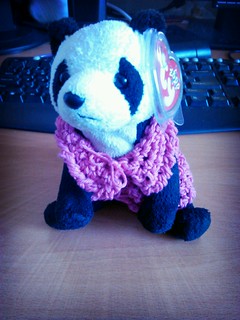
In the meantime, enjoy my latest picture of China the Panda Bear:

China's birthday outfit

Thursday, August 23, 2012

The Young Genealogist: There is NOTHING wrong with them (and here's how to keep them into genealogy)

I got started with this blog post on the fact that there's yet another article accusing young genealogists of being deficient in some way or too stuck on themselves to be in genealogy, or too addicted to the computer to be interested in anything else. Sorry this will get a little long, but its worth sticking through, I promise!

"You don’t even think about your roots. In your 20s and 30s you’re busy creating your own identity.”
"These younger people usually had some kind of disconnect in their family, or a missing relative, and were “trying to fill a hole”, she says."
“Because it’s a lot more focused on comperuterisation, that brings the younger generation through. It is on the internet.”

These are quotes from Michelle Patient, President of the New Zealand Society of Genealogists.

Michelle, I want to point out that you are not a psychologist nor a psychiatrist, so I question the validity of your statement. Should you have proof that we're too busy creating our own identity to care about others/our genealogy in our 20s and 30s, please feel free to email me.

At first I was offended by the idea that she seems to think that younger genealogists are motivated only by negative causes to pursue a lifelong hobby that takes many years to fulfill. Then I thought about it as I munched on my lunch...

...she's confusing "spark" or inspiration with motivation.

You see, I got into genealogy when I was 10 years old. I found a piece of paper among the things I inherited from my grandmother. She was an awesome woman whom I fondly miss, but I knew her quite well as she had spent quite a bit of time with my family in our houses. My "spark" was not the death of my grandmother, but the piece of paper.

That piece of paper sparked an interest in detective work. Aside from the Disney movies, my mother and father introduced me to TV Shows like 21 Jump Street, Law and Order, CHIPs, Cagney and Lacey, Charlie's Angels, The Untouchables, and NYPD Blue (up until the episode where they started showing nudity, at which point I couldn't watch it anymore) along with horror/puzzle shows like the Twilight Zone reboot, Tales from the Crypt, Unsolved Mysteries and the old Rod Sterling Twilight Zone.

What did I take away from this? I hate all the blood, the guts, and the violent gore - but I was hooked on solving the puzzle of the case. And then I remembered the piece of paper, with names of some great-uncles I knew. So I took the Internet and in searching through AOL, came across a link to their genealogy community amongst the various links for detective fans. That in turn led me to their message boards, where someone got me to Rootsweb where I learned how to find the right courthouses, and I started writing letters. As I received each piece of the puzzle, my brain began to whir with possibilities and I studied the history of the areas my family is from, learning about the daily life of a person there and then, and eventually, I started traveling to places my family had been, learning more and more - and with the explosion of information from the Internet, I've gradually progressed to a researched and sourced tree that goes back to the 1700s on both sides of the family.

I continued throughout my 20s and 30s and I met more and more young genealogists like myself, who got started in different ways. Many got hooked because of school projects that got them started. Others were like me - finding something and wanting to know more. Some saw genealogists on TV, helping solve brilliant cases of inheritance treasure and death. Others wanted to know more about their family because they saw history as names and dates and thought there was more to it. Some wanted to know what the heck their parents and grandparents saw in the hobby, :-). Some just liked the pictures.

Rarely have I met the young genealogist who has said they were lacking something in their life. A few have mentioned they were adopted, and were looking into that, and a few have mentioned that the death of a grandparent motivated them to make sure their life and family was documented for the future. But these have been few and far between the many hundreds of young genealogists I have met.

The other issue I want to address is the idea that we're all technology junkies between 20-30 nowadays. Yes, we are all addicted to using our smartphones. But that doesn't mean there aren't genealogists who still write letters, travel, trade photographs, and other non-technology motivated tasks - we use the technology to assist with this. We don't need everything on the computer just to have fun in genealogy.

Michelle Patient, if you want to motivate younger folks to participate and stay in genealogy, you have to have people actively working to let the young folks in. Putting the schools in the family history fair is a great idea, but you also have to demonstrate to the schools how doing your family tree helps with critical thinking, essay writing, building research skills, budgeting, planning, organization, and leads to a lifelong hobby to help you interact with others for the rest of your life.

You also have to work to let the young folks in. Here in the States, often genealogy societies have people in positions from their 60s until they die, leaving no place for young folks to participate except in perhaps "social media" or "website design". We don't have an attention span anymore to stick around for 40 years, waiting for someone to die off so we can get involved. Putting projects together such as digitizing old photos, matching them to current locations, working with GPS, doing oral interviews over Skype and in person, and collecting stories are great ways to get young folks involved and keep them in genealogy for a long time.

Here are some more ideas: working with the Eagle Scout candidates in Boy Scouts, working with the Gold Award candidates in Girl Scouts - they often do historical cemetery projects, cleaning and categorizing, or installing historical markers in towns here, compiling town or church histories, etc. Their service can be of great help to genealogists every where, and yet, they are often an overlooked resource. Same thing with many community service groups - they can clean cemeteries, make lists of names, take town photographs, research old photos, etc.

Creating ways to make cemeteries less scary to young folks can also help. Halloween parties in cemeteries, cemetery walks with tales about the people there and their lives are both great ideas and can also help cut down on cemetery vandalism, as people realize how valuable those tombstones are. Making museums more active can also help, as it prompts interaction with younger folks. The Cantigny First Division Museum is a great example of this ideal near where I live - its design has received numerous national awards.

Also - you can think of alternative uses for genealogy. Who would have thought that antique spinning wheel owners would get interested in it? Or that knitters would be able to run whole genealogies on the patterns passed down from generation to generation? Or that Italian Stregheria (think similar to Wiccans) would be interested in finding their ancestry? Think outside the box to involve these folks in your activities as well. New Zealand has a huge, wonderful history with the fiber industry - it would be wonderful for those of us in the States to get to learn more about it. Could you involve folks like Wiccans in tracing the alternative religions of New Zealand and get them in love with genealogy as well?

Lastly, most genealogy societies have their meetings on a weekday in the middle of the day. Younger folks are in school, at work, and definitely not available for many society meetings. Moving meetings to a Saturday or evening can really help bring in a younger demographic, as more of them are able to come outside of their obligation time.

Michelle Patient, I hope you realize that you CAN entice younger folks into genealogy and they're not deficient or defective in some way, and that you can motivate rather than just "spark" their interest. Good luck to the New Zealand Society of Genealogists!