Wednesday was another great Chicagoland Craft Collective meeting. I learned how to make a really cool papercraft - an ornament that was 3D! Its on my tree now.
As you can see above, there are some very talented people in the Chicagoland Craft Collective that I highly recommend people come and meet. They have talents across the board from fiber crafts to paper crafts to sewing to embroidery to beading and jewelry, and there are professional sellers that are part of the group as well as the head of Craft Critique and talented crafters a plenty!
Next month we are going to do needle felting and I'm super psyched for it! I've had a kit at home and wanted to know more about how to use it, but I was going to wait for the class in April at the Westmont Public Library - so this is a lot sooner!
I'm working on a test crochet for a friend-designer on Ravelry that's turning out really cute. I horribly had to start over due to poor yarn choice on my part, but its starting to come together again. Anyway, will update more when I get the Black Raspberry Hat done - its about darn time I released that pattern! ;-)
My new pattern! This was a fun one. It actually started as an idea for a jacket, and then that didn't work, and it sat in my stash on the needle I left it on for months. I was starting to get out my Holiday things and found that the 2002 Holiday Teddy ornament has this adorable bonnet. Then I got thinking, and...
This is a simple drop stitch pattern that has minimal finishing and would be suitable in any fun, furry and nubby yarn. Lion Brand's Fancy Fur would be a good example, since the yarn that I originally made this in, Yarn Bee Playful, was discontinued. Sirdar Valentino might also be an interesting yarn to try.
Find the Festive Winter Bonnet in my Ravelry Store or here.
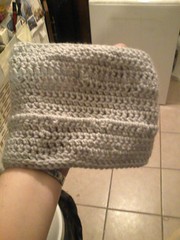
A quick project, a neckwarmer for the husband. The pattern only has two lines across a five row repeat, and then a switch in direction.
Worsted Weight Yarn (I used a mystery grey wool I had laying around) Yarn Needle Size F Crochet Hook
(US Terminology)
Chain 30. Chain 2 at the beginning of every row. Extended single crochet across row. Every five rows (as in, 1,2,3,4,5 then this one), do one row of front post extended single crochet. Stop when desired width is reached.
Extended Single Crochet down width side of project. Every five rows of Extended Single Crochet, do one row of alternating front post extended single crochet and back post extended single crochet.
Stop when desired length is reached. Leave a long tail. Sew together and weave in ends.
Simple, tidy, just enough ornamentation to make me not want to go crazy but simple enough the man still likes it.
I've been working on stuff for the Xmas sale of the Knitting Guild, and the thought occurred to me that this might be a great chance to use up my smaller stashes of LB Homespun (1-3 skeins) and Fleece Lite (2.75 skeins, really, I started a hat and had to cut it off my loom because it tangled so much). I started with my favorite pattern, Ruffled One Skein Scarf by Liz Laferty, but had to stop because my knitting needles were bothering my hands. So I started crocheting them and had a very prolific trip to Minnesota this past weekend. I should have brought another project, but oh well, I forgot it.
Anyway, the crochet ruffles are fun because I changed them up as I completed them. Some have more rows, some have more increases, the one I'm working on now has less increases and more rows, etc.
Flickr looks like it got done automatically posting my picture of the scarves, so I'm going to go check it out!
Hi all! I promised a genealogy entry and I found the perfect topic.
To celebrate the 90th anniversary of the Transcontinental Motor Convoy, a reenactment took place. One of the stops on the tour was practically on my doorstop, at the First Division Museum at Cantigny Park.
Different from the first and second tour, the convoy had vehicles from many wars, all the way up to Desert Storm.
What's that? You never heard of the first Transcontinental Motor Convoy from 1919 or the second in 1920?
Do you have any idea what they accomplished? Well, I didn't either. So I had grabbed a knowledgeable comrade (who's intending to get a Masters in military history), and started some research.
The first one was done to raise awareness of the state of the Lincoln Highway. The road was in such horrendous shape that they found bridges collapsing under the weight of the 81 military vehicles, and they barely got 60 miles per day!
At each stop, the convoy was greeted with barbecues, dances and very well received.
Most people agree the first convoy was a success in that they got a world record for the longest distance traveled by a motor convoy, public support for the military and repairing roads was higher than when they left.
The second convoy, done in 1920, was done to raise public support for a national highway system. It was a bit smaller, about 50 vehicles, and found issues with the Mississippi flooding, and impassable desert sands in the Southwest.
Its debated the effect the second one had - while the crew was again greeted with parties and press, they failed to garner support for a national highway bill (though a bill passed in 1921).
Longterm, these convoys did have an effect on the future of America. President Eisenhower, a rider on the first convoy, supported the Federal Aid Highway Act of 1956 (which created many of the highways we know and love today), partly because of his experiences with the first ride and even told some stories about it in his book, At Ease: Stories I Tell to Friends (Doubleday and Company, Inc., 1967).
This new convoy, as we were told, has more than a single purpose -
1. To celebrate the anniversary of the 1st convoy 2. To celebrate the 200th anniversary of President Lincoln 3. To celebrate the fine work of the US military.
In all, I think that it succeeded. They visited Cantigny on the same weekend as the Fine Art Fair, and seemed to have quite a few visitors. Many were little kids who hadn't seen anything like that before.
Anyway, getting back to the genealogy of the convoy...
1. Learn more about it. NARA has a section on their website under "America on the Move".
2. Search the newspapers for the local community. ALL of them would have covered this, as it was a big deal when the convoy came to town.
For example, the Fort Wayne Gazette from Fort Wayne, Indiana on July 19, 1919 discussed the aspect of H. S. Firestone donating vehicles, and the Reno Evening Gazette from Reno, Nevada on September 6, 1919 discussed statements by Lieutenant Colonel C.W. McClure, the leader of the convoy, and the efforts of Captain J.H. Murphy, who was in charge of recruiting.
An article from the conclusion of the trip on September 7, 1919 in the Oakland Tribune, gives a list of official observers from the trip. You never know what you might find!
I suggest if you try Ancestry.com, to search 1919 for keywords "Transcontinental Motor Convoy" and see what happens.
4. Check out more about the new convoy at the MVPA website.
This video was taken by the MVPA as the convoy was going through Iowa.
Sources: Ancestry.com - Copies of the Reno Evening Gazette, Oakland Tribune, and Fort Wayne Gazette. MVPA.org AmericasLibrary.gov Eisenhower.archives.gov History.sandiego.edu
Aren't those incredible? They look like they might be one of the few and proud legwarmer patterns that STAY UP of their own accord and HUG, not slouch.
And the cables make me think they'd be a sexy knit, rather than a poke-your-eyes out stockinette field like so many other legwarmer patterns.